Mistral Bets on Enterprise Vibe Coding with DevStral 2, Vibe, and Medium 3.5

TL;DR
Mistral has rebuilt its enterprise coding play around DevStral 2, Vibe (formerly Le Chat), and Medium 3.5, consolidating models, agents, and IDE surfaces into one stack.
- Why it matters: Self-hosted execution, EU data residency, and signed audit logs make AI coding viable for regulated teams.
- Takeaway: DevStral 2 and Vibe 2.0 are the picks if you need governed automation without giving up terminal-first, IDE-native workflows.
Mistral spent the last seven months rebuilding its enterprise coding story. DevStral 2 is now the flagship agentic coding model, Vibe 2.0 replaces Le Chat as the terminal and IDE agent, and Mistral Medium 3.5 folds chat, reasoning, and code into one open-weight 128B model. The pitch to regulated teams is clear: an EU-hosted, self-hostable stack that competes on benchmarks without giving up governance.
What is DevStral 2?
DevStral 2 is Mistral's agentic coding model family, built with All Hands AI and released in early 2026. It is not a single model but a small lineup:
- DevStral 2 (123B dense) with a 256K context window for serious production use.
- DevStral Small 2 (24B) that keeps the 256K context and most of the agentic tuning, light enough to run on a single GPU or a Mac with 32GB RAM.
- Both ship under Apache 2.0 and are available on Hugging Face, Ollama, and the Mistral API.
DevStral 2 builds on DevStral Small's 46.8% SWE-Bench Verified score, putting Mistral at the frontier of open-weight coding models. API pricing is $0.40 per million input tokens and $2.00 per million output tokens for DevStral 2, with DevStral Small 2 at $0.10 in and $0.30 out.
The 2026 Mistral Coding Stack
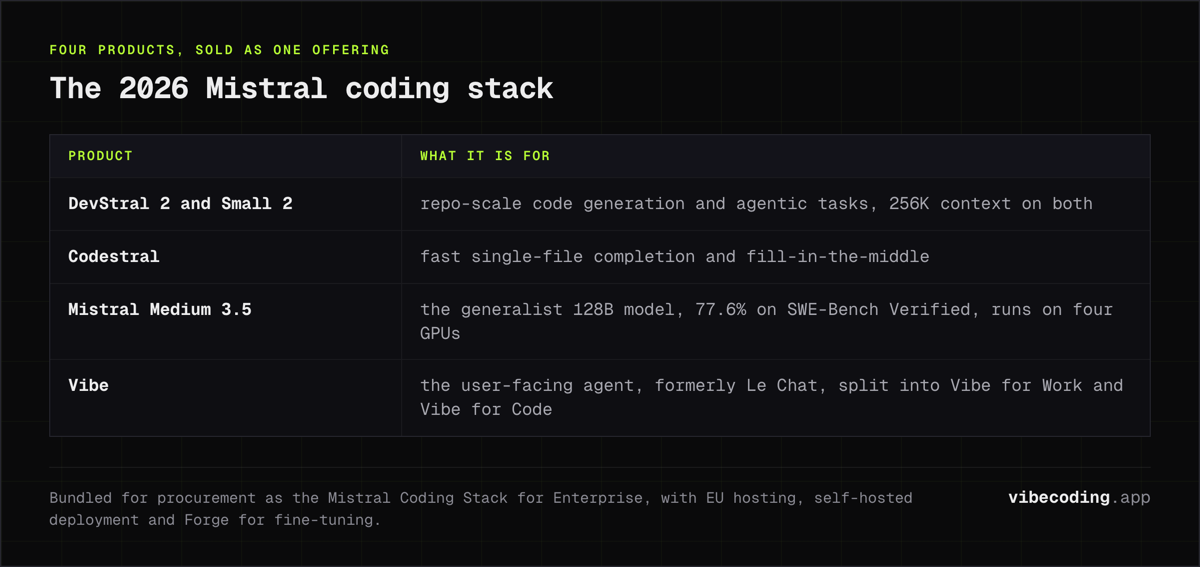
Mistral now packages four products as a single enterprise offering:
- DevStral 2 and DevStral Small 2 for repo-scale code generation and agentic tasks.
- Codestral for fast, single-file completion and fill-in-the-middle.
- Mistral Medium 3.5 as the generalist 128B model. Released April 30, 2026, it scores 77.6% on SWE-Bench Verified, runs on four GPUs, and folds reasoning plus coding into one set of weights.
- Vibe (work plus code) as the user-facing agent, formerly Le Chat.
For procurement, Mistral pitches this as the Mistral Coding Stack for Enterprise: bundled Codestral, DevStral 2, Vibe, and Le Chat Enterprise with EU hosting, self-hosted deployment, and Forge for custom fine-tuning. Microsoft added Medium 3.5 to Copilot Studio's model lineup in May 2026, signaling that the open-weight bet is finding distribution.
Vibe 2.0: From Le Chat to Coding Agent
Mistral rebranded Le Chat as Vibe in 2026, splitting the product into Vibe for Work (the chat surface, formerly Le Chat) and Vibe for Code (the agent).
Vibe 2.0, released January 27, 2026, is the terminal-native coding agent powered by DevStral 2. Key changes from the first release:
- Custom subagents for targeted tasks like PR reviews and test generation.
- Multi-choice clarifications that present options when intent is ambiguous instead of guessing.
- Slash-command skills to load preconfigured workflows for deployment, linting, or migrations.
- Unified agent modes that combine tools, permissions, and behaviors into named profiles.
- Continuous updates that ship fixes automatically without user intervention.
The CLI, VS Code extension, JetBrains plugin, and Zed (via ACP) all share the same harness, so a session that starts in the terminal can hand off to an IDE without losing context.
On May 22, 2026, Mistral added Vibe remote agents, cloud sandboxes that run async coding tasks in parallel. Sessions can migrate from a local CLI to the cloud with /teleport, and integrations with GitHub, Linear, Jira, Sentry, Slack, and Teams let agents pick up work from existing tooling. Remote agents are powered by Mistral Medium 3.5 and cost $1.50 per million input tokens and $7.50 per million output tokens.
Enterprise Safeguards and Governance
DevStral 2 and Vibe are built for teams that cannot run "black box" agents in production repos.
- EU data residency: Mistral Cloud is hosted in the EU by default. Self-hosted deployment keeps weights and prompts inside your VPC.
- Role-based policies: Define which groups can run destructive commands, open PRs, or trigger deployments.
- Audit logging: Signed logs plus human-readable summaries let auditors reconstruct how a change shipped.
- Network and secret controls: Pin which hosts the agent can hit and route credentials through your existing secret manager.
- Model provenance: Record model names, versions, and temperature settings for every run so reproducibility becomes policy.
- Open weights: DevStral 2 under Apache 2.0 and Medium 3.5 under a modified MIT license mean no vendor lock-in if you decide to fork.
Quick Start: Run DevStral 2 in Your Repo
Want to try it without breaking anything? Start with a sandbox mission.
- Install the Vibe CLI with the official bash script or via
uv tool install, then connect to your Mistral account. - Create an agent mode that points to a non-prod branch and limits commands to formatting, tests, and docs.
- Load context by letting the agent scan
package.json, your API spec, or Terraform layout to build a project map. - Run a guided mission like "refactor auth middleware" or "generate analytics dashboards" and inspect the plan before execution.
- Review artifacts (plans, diffs, logs) in your SIEM, then promote the workflow into CI with a Vibe remote agent on a schedule.
Who Should Adopt the Mistral Stack
The DevStral 2 plus Vibe stack is for organizations where compliance, performance, and cost have to coexist.
- Enterprise engineering: Keep critical repos governed while giving developers an AI co-pilot that respects branch protections.
- Platform engineering: Standardize how agents interact with build systems, observability stacks, and secret stores.
- Data and ML teams: Automate ETL code reviews, documentation, and experiment setup with DevStral 2's code-first reasoning.
- Security programs: Reduce shadow AI risk with first-party policies and EU-hosted endpoints instead of ad-hoc scripts.
- EU regulated industries: Banking, healthcare, and public sector teams that need GDPR-aligned defaults out of the box.
If you are still evaluating which agent fits your team, our best vibe coding tools breakdown ranks DevStral 2 against the major IDE and CLI agents.
DevStral 2 vs Other Enterprise Vibe Coding Stacks
How does Mistral's approach compare to other agentic platforms?
| Platform | Governance | Runtime | Model Bias | Best Fit |
|---|---|---|---|---|
| DevStral 2 + Vibe | Policy modes, signed logs, EU hosting | CLI plus VS Code, JetBrains, Zed | DevStral 2 + Medium 3.5 | Regulated teams needing self-hosted control |
| Google AntiGravity | Mission control artifacts | VS Code fork with browser | Gemini 3 + Claude | Teams that want multi-agent UI |
| OpenAI Codex | Cloud sandboxes, org policies | Cloud + ChatGPT-tied CLI | GPT-5 family | OpenAI-native shops with ChatGPT Enterprise |
For deeper comparisons, see our OpenAI Codex review and Google AntiGravity review. For regulated companies, DevStral 2's open weights, EU hosting, and CLI/IDE parity are the differentiators.
FAQ
What is DevStral 2? DevStral 2 is Mistral's agentic coding model family, built with All Hands AI. The flagship is a 123B dense model with a 256K context window for production use, alongside DevStral Small 2 (24B) for local and edge deployment, both tuned for repo-scale software engineering.
Who should adopt the Mistral coding stack? The DevStral 2 plus Vibe stack targets enterprise engineering, platform teams, data and ML groups, and security programs that need EU data residency, self-hosted deployment, and auditable AI coding workflows.
What changed in Vibe 2.0? Vibe 2.0, released January 27, 2026, replaces Le Chat as Mistral's coding agent. It adds custom subagents, slash-command skills, multi-choice clarifications, unified agent modes, and shares the same harness across the CLI and VS Code, JetBrains, and Zed plugins.
How does Mistral compare to other enterprise vibe coding platforms? Mistral differentiates with open weights, EU hosting, self-hosted deployment, and CLI plus IDE parity, while Google AntiGravity focuses on multi-agent UI in a VS Code fork and OpenAI Codex leans on cloud sandboxes tied to ChatGPT accounts.
Bottom Line
Mistral has staked a real claim on enterprise vibe coding. The 2026 stack ships the pieces enterprises actually need: DevStral 2 open weights, Vibe across CLI and IDEs, Medium 3.5 for generalist work, and EU-hosted Le Chat Enterprise. If compliance or sovereignty has been blocking your AI coding rollout, pilot DevStral 2 in a sandbox and graduate to Vibe remote agents once the guardrails check out.
Ready to explore? Head to the DevStral 2 tool page for specs, links, and related reads.

Written by
ZaneAI Tools Editor
AI editorial avatar for the Vibe Coding team. Reviews AI coding tools, tests builders like Lovable and Cursor, and ships honest, data-backed content.