


Bolt.new vs Lovable
Last reviewed:
The definitive head-to-head comparison for Vibe Coders.
Bolt.new
Lovable
Quick Comparison
| Feature |  Bolt.new Bolt.new |  Lovable Lovable |
|---|---|---|
| Agentic / Autonomous Mode | ||
| Code Autocomplete | ||
| Chat / Prompt-Based Coding | ||
| Multi-file Editing | ||
| AI Models | Claude, GPT-4o, Gemini (multi-model) | Anthropic Claude powers the build agent; in-app AI features use Gemini, GPT, and more via Lovable's AI gateway |
Scroll down for in-depth category breakdowns ↓
Quick Verdict
It's a close call, depends on your needs
Bolt.new vs Lovable: find out which platform fits your Vibe Coding workflow with a deep dive into AI capabilities, pricing, integrations, and real developer experience. This head-to-head overview highlights what makes each tool unique so you can make the right choice for your next build.
The Winner
Lovable is the Vibe Coding Champion
AI & Coding Features
| Feature | Bolt.new | Lovable |
|---|---|---|
| Agentic / Autonomous Mode | ||
| Code Autocomplete | ||
| Chat / Prompt-Based Coding | ||
| Multi-file Editing | ||
| AI Models | Claude, GPT-4o, Gemini (multi-model) | Anthropic Claude powers the build agent; in-app AI features use Gemini, GPT, and more via Lovable's AI gateway |
| Image / Design to Code |
Bolt.new is built around chat-based full-stack app creation from natural language prompts, while Lovable focuses on no-code full-stack generation (react/typescript/tailwind). Bolt.new uses Claude, GPT-4o, Gemini (multi-model), while Lovable runs on Anthropic Claude powers the build agent; in-app AI features use Gemini, GPT, and more via Lovable's AI gateway. The key question is whether you need agentic capabilities that autonomously handle multi-step tasks, or inline completions that keep you in flow as you type. Review the table above to see which AI features each tool actually offers.
Bolt.newLovablePlatform & Access
| Feature | Bolt.new | Lovable |
|---|---|---|
| Platform Type | Browser App | Browser App |
| Runs in Browser | ||
| Built-in Deployment | ||
| Git Integration | ||
| Open Source |
Bolt.new is a browser app, while Lovable is a browser app. Whether a tool runs in your browser or requires a local install matters for getting started quickly. Built-in deployment means you can go from prompt to live app without switching tools. Consider what fits your workflow, some builders prefer everything in the browser, while others want the power of a local IDE.
Bolt.newLovablePricing & Cost
| Feature | Bolt.new | Lovable |
|---|---|---|
| Free Plan Available | ||
| Starting Price | $20/mo | $25/mo |
| Token / Credit Based | ||
| Can Buy More Credits | ||
| Has Daily / Usage Limits |
Bolt.new is priced at free tier + paid pro/team subscriptions, with a free entry point. Lovable is priced at free / $25/mo and up, with a free entry point. Both tools use a token or credit system, so your actual cost depends on how much you build. Pay attention to daily limits, some tools throttle usage even on paid plans during heavy coding sessions. Check whether you can buy additional credits if you hit the ceiling mid-project.
Bolt.newLovableExperience & Reviews
| Feature | Bolt.new | Lovable |
|---|---|---|
| Beginner Friendly | ||
| Target Audience | Indie hackers, non-technical founders, rapid prototypers | Non-technical founders, designers, indie hackers, agencies |
Bolt.new is accessible to beginners and non-developers looking to build with AI. Lovable is accessible to beginners and non-developers looking to build with AI. The real test is how quickly you can go from idea to working app, setup time, documentation quality, and how intuitive the AI interaction feels all factor into the experience.
Bolt.newLovableFeature data verified monthly. Some entries use automated inference. Report inaccuracy
What to do next
Related Comparisons
Which Should You Choose?
Use these decision criteria to find the right tool for your workflow.
Choose Bolt.new if…
- ✓You want to build and deploy a full-stack web app without leaving your browser
- ✓You're a non-technical founder who needs to prototype quickly without writing code
- ✓You're running a hackathon or need an MVP in hours, not days
- ✓You want Supabase auth and a backend database wired in from the start
- ✓You're starting from a Figma design or an existing GitHub repo
Choose Lovable if…
- ✓You want the fastest path from idea to deployed web app
- ✓You're a non-developer who needs to ship without writing code
- ✓Beautiful UI matters, your app needs to look polished from day one
- ✓You want full-stack generation (frontend + backend + database) in one tool
- ✓You need Figma-to-code workflows for design handoff
Key Differences
Backend approach. Bolt integrates Supabase for your database and backend. Lovable offers Lovable Cloud, a built-in backend with auth and a database managed inside the platform. Both get you a real backend; one leans on Supabase, the other keeps it native to Lovable.
Code and iteration. Both generate real, editable code and both have agent modes. Lovable produces React, TypeScript, and Tailwind, and its Agentic Mode autonomously explores and fixes issues across files with up to 90% fewer errors, backed by AI subagents added in May 2026. Bolt scaffolds full projects and edits them through chat. The day-to-day feel differs, so trying both on the same idea is the fastest way to judge.
Deployment. Bolt offers built-in hosting plus Netlify export. Lovable offers Lovable hosting with custom domains, one-click deploy, and two-way GitHub sync so your code stays portable. Both take you from prompt to live URL; the destinations differ.
Inputs. Both support image-to-code, so you can start from a screenshot or design. Bolt highlights Figma import, while Lovable adds Draw-to-Build so you can sketch an interface and have it built. If you design first, both fit.
Models. Bolt routes work through frontier agents from multiple providers, including Claude, GPT, and Gemini, without exposing model choice. Lovable's build agent is powered by Anthropic Claude, supports the Claude MCP, and is listed in the Claude Marketplace. Both keep model handling managed for simplicity.
Pricing model. Bolt is token-based: a free tier with daily limits, then Pro at $25/mo with 10M tokens that roll over. Lovable is credit-based: 5 credits per day free, then 100 monthly credits on Pro at $25/mo, with a $50/mo Business tier for teams. Both meter generation, so your spend tracks how much you build.
Why these tools are being compared
Researched 2026-07-09Bolt.new and Lovable are the closest pairing in this category: both are browser-based, prompt-first platforms that turn a description into a working full-stack app and deploy it. They overlap heavily, so the comparison is less about category and more about feel, backend, and pricing.
Bolt.new runs in the browser on StackBlitz WebContainers. You describe an app, optionally add a screenshot or Figma frame, and it scaffolds a working project, integrates Supabase, and gives you a live preview you can deploy in a click or export to Netlify. It is built for indie hackers, non-technical founders, and rapid prototypers who want speed from prompt to running app.
Lovable is a prompt-first platform that builds full-stack web apps through chat, producing real React, TypeScript, and Tailwind code. Its build agent is powered by Anthropic Claude, and its Agentic Mode explores the project and fixes issues across files with up to 90% fewer errors. Lovable Cloud provides a built-in backend with authentication and a database, one click deploys to a live URL with a custom domain, and two-way GitHub sync keeps your repo in step. In May 2026 Lovable added AI subagents, and it now supports Draw-to-Build and the Claude MCP. It is built for non-technical founders, designers, indie hackers, and agencies, and at roughly $500M ARR it is one of the most widely used tools in the space.
Because both do the same core job well, the right choice usually comes down to backend approach, how the iteration loop feels, and which pricing model fits your build.
Feature and pricing takeaways
Bolt.new starts free with 1M tokens a month and a 300K daily cap, enough to test it and build a small prototype before you feel the limit. Pro is $25/mo, lifts the allowance to 10M tokens, removes the daily cap, and rolls unused tokens forward for up to two months. Teams is $30 per member a month with a per-seat token allotment, and Enterprise is custom. Because it is token-based, heavy generation uses more, so your cost tracks output rather than calendar days.
Lovable's free tier gives 5 credits per day, private projects, unlimited collaborators, and lovable.app subdomains, enough to try it and ship something simple. Pro at $25/mo adds 100 monthly credits with rollover, custom domains, user roles, and the option to remove the Lovable badge. Business at $50/mo layers on more credits, single sign-on, personal projects, the option to opt out of data training, and design templates, with Enterprise available for larger orgs. Like Bolt, it meters by usage, so iterating heavily consumes credits faster.
The two Pro plans land at the same $25/mo headline, and both meter generation, so the deciding factor is rarely the sticker price. It is how far a credit or a token's worth of generation gets you on your specific app, and which backend and hosting you prefer. Build the same small app in both free tiers and see which one reaches a working result with fewer credits and less friction.
Who should choose each tool
If you want a built-in backend managed inside the platform, Lovable. Lovable Cloud bundles auth and a database natively, with custom-domain deployment and two-way GitHub sync.
If you prefer Supabase as your backend, Bolt. It integrates Supabase directly, which suits builders who already lean on that stack.
If you want an agent that autonomously explores and fixes the project, Lovable. Its Agentic Mode is built to investigate and repair issues across files, and it runs on Anthropic Claude with up to 90% fewer errors.
If you design in Figma and want to start from frames, Bolt. Its Figma import and image-to-code make a design-first start straightforward, though Lovable's Draw-to-Build covers the sketch-first path too.
If you want real, ownable React code to carry forward, either works, since both generate editable code; Lovable explicitly outputs React, TypeScript, and Tailwind you can sync to GitHub in both directions.
Interface Comparison
Bolt.new

Lovable
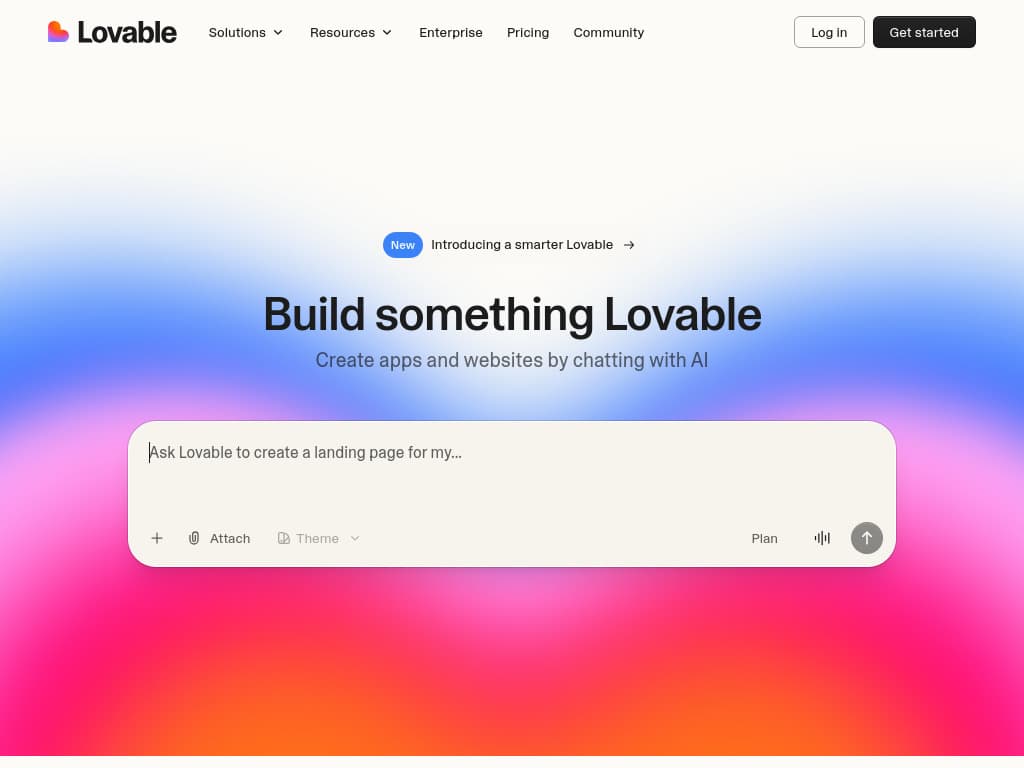
Side-by-side interface comparison
At a Glance
| Detail | Bolt.new | Lovable |
|---|---|---|
| Pricing | Free tier + paid Pro/Team subscriptions | Free / $25/mo and up |
| Trusted Rating | 4.4/5 (Product Hunt) | 4.6/5 (Product Hunt) |
| Category | app-builders | app-builders |
| Best For | Rapid Prototyping | Founders |
| Key Strength | Chat-based full-stack app creation from natural language prompts | No-code full-stack generation (React/TypeScript/Tailwind) |
FAQs: Bolt.new vs Lovable
- What is the main difference between Bolt.new and Lovable?
- Bolt.new focuses on chat-based full-stack app creation from natural language prompts while Lovable highlights no-code full-stack generation (react/typescript/tailwind). Both target app-builders, but their onboarding, AI depth, and pricing models feel different.
- Which tool is better for speed and flow?
- Both Bolt.new and Lovable aim for smooth iteration. Check the feature comparison above to see which matches your workflow, factors like setup time, AI responsiveness, and integration depth matter most.
- How do Bolt.new and Lovable compare on pricing?
- Bolt.new lists free tier + paid pro/team subscriptions, whereas Lovable offers free / $25/mo and up. Consider which aligns with your budget and whether you need free tiers, seat-based plans, or bundled AI features.
- Who should choose Bolt.new vs Lovable?
- Bolt.new fits teams that value Rapid Prototyping, while Lovable suits those prioritizing Founders. If you need category-specific guardrails, start with the tool that matches your daily workflows.
- Is Bolt.new or Lovable better overall?
- "Better" depends on your specific workflow. Review the head-to-head feature comparisons above to identify which tool aligns with your priorities, pricing, integrations, and AI capabilities all factor in.
- Does Bolt.new have a free plan?
- Yes, Bolt.new offers a free entry point: Free tier + paid Pro/Team subscriptions. This makes it easy to trial before committing to a paid plan.
- Can I use Lovable for free?
- Yes, Lovable has a free tier available: Free / $25/mo and up. You can start without a credit card and upgrade when ready.
- Are Bolt.new and Lovable basically the same thing?
- They are very similar: both are browser-based, prompt-first builders that generate and deploy full-stack apps. The differences are in the backend (Bolt integrates Supabase; Lovable offers native Lovable Cloud), the iteration feel, the agent, and pricing details. Trying both on one idea is the fastest way to tell them apart.
- Which gives me a backend with auth and a database?
- Both. Bolt integrates Supabase for your database and backend. Lovable provides Lovable Cloud, a built-in backend with authentication and a database managed inside the platform. Choose based on whether you prefer Supabase or a native, managed backend.
- Do both produce real code I can keep?
- Yes. Both generate real, editable code. Lovable outputs React, TypeScript, and Tailwind and offers two-way GitHub sync, so you can carry the project into a traditional editor and back. Bolt scaffolds real projects you can export, including to Netlify.
- How do their prices compare in 2026?
- Both meter generation and both charge $25/mo for Pro. Bolt is token-based (free with 1M tokens a month, then 10M on Pro with rollover, Teams at $30 per member), and Lovable is credit-based (5 credits a day free, 100 monthly credits on Pro, and a $50/mo Business tier). Because pricing tracks usage, the practical test is how far each gets you on your app, so compare them on the [same prototype](/blog/lovable-pricing-2026).
- Which one has the stronger AI agent?
- Lovable's build agent runs on Anthropic Claude, and its Agentic Mode explores the project and fixes issues across files with up to 90% fewer errors, backed by AI subagents introduced in May 2026 and Claude MCP support. Bolt uses frontier agents from multiple providers without exposing the model. If an autonomous, Claude-powered repair loop matters to you, that is [Lovable's](/tools/lovable) lean.
The Bottom Line
Bolt.new and Lovable are genuinely close, and both are strong choices for turning an idea into a deployed full-stack app without writing the stack yourself. Bolt leans on Supabase and a Figma-friendly, token-based flow. Lovable offers a native backend through Lovable Cloud, an autonomous agent powered by Anthropic Claude, and credit-based pricing, while producing real React code you can own. Since both Pro plans sit at $25/mo and both deploy for you, the smartest move is to build the same prototype in each free tier and let the iteration loop, backend fit, and credit efficiency decide.
Looking for more options?
Explore comprehensive alternative guides for both tools to find the perfect fit for your needs


Keep comparing
Ready to make your choice?
Try both tools for free and discover which one fits your vibe coding workflow

