
ShipClarity
The QA pass your AI-built app never had.
About
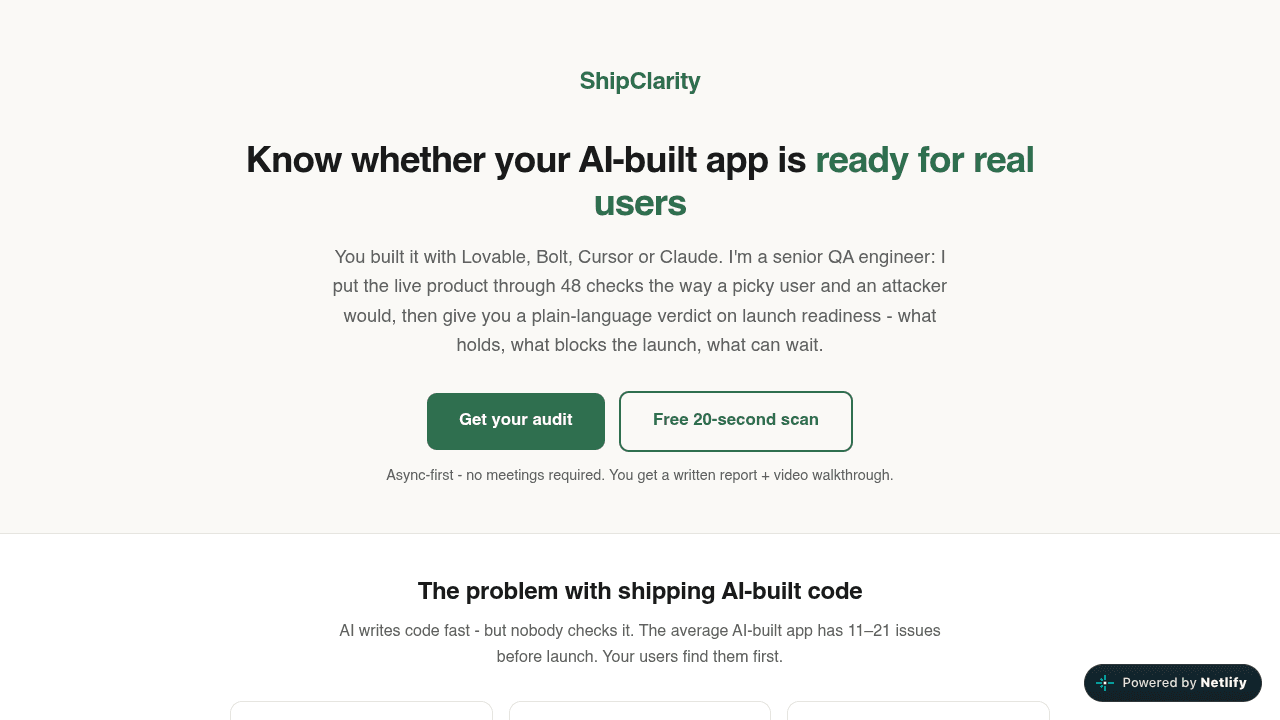
ShipClarity is a one-person QA practice: Novruz Veliev, a senior QA engineer with eight years testing real products, who runs manual pre-launch audits of apps built in Lovable, Bolt, Cursor and Replit. The distinguishing thing is the access model. He does not take the repository. He tests the live product the way a first paying user would, which is the path most AI-built apps have never been walked down by anyone but their maker. The engagement is async-first and needs no meetings, which is unusual in this directory and matches how the audience already works. The deliverable is a written report with steps to reproduce, severity and priority on each finding, video walkthroughs of what he hit, and a plain verdict on what blocks a launch against what can wait. The paid audit runs 48 checks against the live product, of which the free scanner automates 17. Published prices: a Quick Check at $290, a Pre-Launch Audit at $790, and a QA Partner retainer at $1,490 a month. He also runs a free automated scanner at scan.shipclarity.app, which does the 17 checks a machine can do from outside the app with no signup and no login, and says plainly which of the 48 checks in a Quick Check need a human with an account. We ran it against vibecoding.app on 12 September 2026. It returned per-check detail with the actual values it read, marked one check inconclusive rather than guessing, and closed by listing the six things it could not test and saying none of them had run. Published turnaround: 48 hours for a Quick Check, three to four days for a Pre-Launch Audit.
Services
Quick Check
A fast pass over the live product for the failures that stop a first paying user: broken flows, dead ends, things that do not do what the button says.
Pre-Launch Audit
Full manual audit of the live app with a written report: steps to reproduce, severity and priority per finding, video walkthroughs, and a verdict on what blocks launch.
QA Partner
Ongoing QA on a retainer: regression passes on each release rather than one audit before launch.
Vibe Tool Expertise
Tech Stack
Problems This Agency Can Fix
AI coding tools often generate code with exposed API keys, missing input validation, broken authentication, and insecure data handling. These vulnerabilities can lead to data breaches, unauthorized access, and compliance failures.
Authentication is one of the most common failure points in vibe-coded apps. AI tools frequently generate insecure auth flows, missing session validation, broken password resets, and improperly configured OAuth.
AI-generated database schemas often lack proper indexes, have no Row Level Security, use inefficient query patterns, and create data integrity problems. These issues worsen as your app grows.
AI-generated codebases frequently have duplicated logic, inconsistent patterns, missing error handling, no TypeScript strict mode, and poor separation of concerns. This makes maintenance and feature additions increasingly difficult.
AI tools often generate API integrations with missing error handling, no retry logic, hardcoded endpoints, and insecure credential storage. These integrations break silently and are difficult to debug.
AI-generated UIs often look great on desktop but break on mobile devices. Missing responsive breakpoints, oversized images, touch-unfriendly controls, and fixed-width layouts create poor mobile experiences.
AI-generated apps often lack proper meta tags, structured data, semantic HTML, and server-side rendering. This makes them invisible to search engines and kills organic traffic potential.